

I’d like to share a story with you.
Janet is a client, a former colleague, and a very dear friend of over 25 years. Recently, she experienced a serious car accident — one of those moments where everything can change in an instant.
What Janet reflects on afterwards offers a powerful and very personal insight into something we don’t always see or talk about — how our bodies respond to shock, and how those experiences can stay with us long after the moment has passed.
I’m grateful to her for putting her experience into words so openly.
Janet’s Experience
“As a therapist working on the craniosacral system, I regularly support clients experiencing trauma. I feel privileged to witness the body’s responses and assist in that process.
Recently, I was involved in a bad car accident. By a matter of seconds and inches, I avoided being hit head-on at terrifying speed by an out-of-control driver.
Those seconds and inches saved my life.
My car, along with two others, was written off — but I walked away without a single visible scratch or bruise.
Trauma, however, isn’t defined by visible injury. It can extend much deeper, embedding itself within the cells and tissues of the body.
I am deeply grateful that my fight/flight/fright response activated quickly enough to protect me.”
Understanding trauma beyond the event
Many of us think of trauma as something purely psychological, or something that only follows major life events. Yet trauma can arise whenever our system experiences a level of threat that feels overwhelming in that moment.
The body’s response is extraordinary. In a fraction of a second, everything shifts — breathing changes, the heart responds, muscles prepare, and awareness sharpens. These reactions are not a problem; they are what keep us safe.
The difficulty comes when the body doesn’t get the signal that it’s safe again.
Janet reflects
“How amazing our bodies are. This system can quite literally be lifesaving.
But what happens when it doesn’t switch off?
We don’t need to live on red alert — yet when we do, the consequences can be significant.”
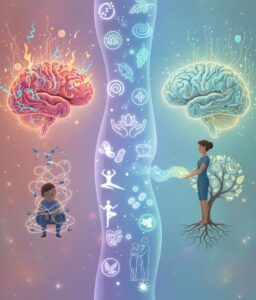
When the body holds trauma
Increasingly, we understand that our experiences don’t just live in our thoughts or memories. They are also reflected in how the body feels and responds — in tension, in breathing patterns, in sleep, and in that subtle sense of being either settled or on edge.
You may recognise it as a constant background alertness, a difficulty in truly relaxing, or a feeling that your system can’t quite switch off — even when you want it to.
Sometimes it’s obvious where that feeling began.
Sometimes it isn’t.
Janet’s turning point
“Through my work, I understood what was happening — and I knew I needed support.
That’s where craniosacral therapy came in, with my colleague and friend Vicky Smith.
After just one session, the transformation was profound. The shift felt like night to day.
Before, it felt like an out-of-control hamster running at full speed in my chest.
Afterwards, I returned to a sense of calm and balance.”
The role of CranioSacral Therapy
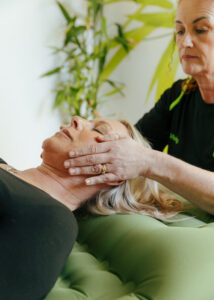
At Tayloredfit Physio, my approach brings together over two decades of physiotherapy with specialist training in CranioSacral Therapy and movement-based rehabilitation.
Over the years, I’ve become increasingly interested in the quieter side of the body — how it holds stress, adapts to trauma, and tries to protect us in ways we may not even realise.
CranioSacral Therapy works gently with the body and nervous system, creating space for things to settle. Rather than forcing change, it supports the body in finding its own way back towards a more regulated, balanced state.
People often describe a sense of calm they hadn’t realised they were missing — a feeling of coming back to themselves.
When stress becomes ‘normal’
“I was fortunate to receive treatment quickly. For many people, that doesn’t happen.
Their ‘hamster’ keeps running for weeks, months, even years — and that level of stress becomes normal.
But maintaining that state is exhausting. Eventually, the body pushes back with symptoms.”
These can show up in many different ways — from headaches and fatigue to anxiety, jaw tension, digestive issues, or a general sense that something just isn’t quite right.
Often, people go through multiple tests or treatments without finding lasting answers.
A supportive approach
CranioSacral Therapy isn’t a replacement for medical care, but it can be a valuable complement — particularly when something doesn’t feel quite right despite everything looking “fine” on paper.
The body is incredibly good at holding things together.
Sometimes for a little while.
Sometimes for a very long time.
Until it doesn’t need to anymore.
Janet’s closing words
“I’ve seen the impact of craniosacral therapy for years — and now I’ve experienced it myself.
If this resonates with you, no matter how long ago your trauma occurred, it is worth exploring.
It is gentle, powerful, and works with the whole body.
You’ve got nothing to lose — and potentially everything to gain.”
A final thought
If anything in Janet’s story feels familiar — whether it relates to something recent or something that’s been sitting quietly in the background for a long time — you’re not alone.
Sometimes, simply recognising what your body has been holding is the first step. From there, there are gentle ways to begin supporting it.
If you’re curious to explore this further, we’re always happy to have a conversation. You can find out more or get in touch with the team at our clinic in Langley Park by visiting here. Alternatively, go ahead and book an appointment with either Vicky, Mark or Ileana here.
No pressure — just a space to ask questions and see what might feel right for you.